
Beyond What Is Expected — 1 Samuel 1:21–28 Sermon | Ed Kennedy
Beyond What Is Expected — 1 Samuel 1:21–28 Sermon | Ed Kennedy
Topic: 1 Samuel, change, Christian Living, Church Growth, Church Leadership, dedication, discipleship, Faith, Family, forgiveness, generosity, God's Plan, God's Will, grace, Hannah, Jesus Christ, marriage, Missions, obedience, prayer, relationships, Sacrifice, Samuel, Serving Others, Spiritual Discipline, spiritual growth, surrender, trust

Letting Go of the Past and Making Room for What God Wants to Do
Scripture: 1 Samuel 1:21–28
Pastor Ed Kennedy | October 18, 2026
Sermon Series: Dedicated to the Lord
What Would You Be Willing to Give for a Different Future?
Most of us can imagine something we’d like to see change.
Perhaps we long for a healthier marriage, a restored friendship, greater spiritual maturity, or a deeper understanding of God’s Word.
Maybe we want to become more generous with our resources, more intentional with our time, or more involved in serving others.
We may even have a growing concern for our church, our community, or people who have not yet heard the Gospel.
But wanting a different future and pursuing that future are not the same thing.
In this message from 1 Samuel 1:21–28, Pastor Ed Kennedy returns to the remarkable story of Hannah, a woman whose faith helped lay the foundation for the ministry of Samuel—one of Israel’s most significant prophets and leaders.
Hannah had experienced profound disappointment and family turmoil. Yet she brought her burdens before the Lord, trusted Him with her deepest longing, and eventually fulfilled an extraordinary promise.
Her story presents a challenging question:
What are we willing to release—and what are we willing to sacrifice—to pursue the future God has placed on our hearts?
Pastor Ed develops two commitments:
- Let go of the past.
- Be willing to sacrifice beyond what is expected.
Both require more than good intentions.
They require faith expressed through obedience.
1. Hannah’s Story: A Foundation of Faith
Read 1 Samuel 1:21–28
The opening chapter of 1 Samuel introduces a troubled family.
Hannah’s husband, Elkanah, had taken a second wife, Peninnah, after Hannah was unable to have children. The resulting relationships brought sorrow, tension, and painful conflict into the household.
Hannah carried a burden she could not resolve through her own strength.
Instead of allowing her circumstances to determine her future, she brought her distress before the Lord.
Earlier in the chapter, Hannah prayed that God would give her a son. She promised that if He answered her prayer, she would dedicate the child to Him.
God answered, and Samuel was born.
But Hannah’s story did not end with answered prayer.
In verses 21–28, we see what happened when she followed through on her promise.
A Promise That Required Extraordinary Trust
After Samuel was weaned, Hannah brought him to Shiloh, where the tabernacle was located.
She did not simply present him for a brief ceremony and return home.
She entrusted him to a life of service to the Lord under Eli’s care.
For a mother who had waited so long for a child, this was an extraordinary act of surrender.
Hannah was willing to give back to God the very gift she had longed to receive.
Her husband, Elkanah, affirmed her decision.
Pastor Ed sees this as evidence of meaningful spiritual growth within the family. The story moves from relational turmoil toward a shared commitment to honor the Lord.
Hannah’s dedication of Samuel reveals a faith that went beyond words and became costly obedience.
2. What Is God’s Preferred Future?
Pastor Ed uses the phrase preferred future to describe a burden or vision God places on a person’s heart concerning something He may want to accomplish in or through their life.
It is more than a passing wish.
It is a concern that continues to draw us toward prayer, obedience, and action.
Biblical Examples of God-Given Burdens
Throughout Scripture, we encounter people who carried significant concerns about what needed to happen.
Moses had a burden for the deliverance of Israel from slavery.
Joshua was called to lead Israel into the Promised Land.
David desired to prepare for the construction of a temple honoring the Lord.
Nehemiah carried a burden for Jerusalem and the rebuilding of its walls.
Paul devoted his life to spreading the Gospel.
Their experiences were different, but each illustrates how a God-directed concern can shape a person’s priorities and actions.
Hannah’s burden involved her family and the child she longed to receive.
And through Samuel, God’s work extended far beyond her household.
What Might a Preferred Future Look Like Today?
A God-honoring vision for the future may involve:
- Growing in knowledge of Scripture
- Becoming more faithful in prayer
- Rebuilding trust within a relationship
- Strengthening a marriage or family
- Practicing generosity
- Serving people in need
- Sharing the Gospel
- Developing greater spiritual maturity
- Helping the next generation grow in faith
These desires must be tested against Scripture and pursued with humility.
We cannot assume every personal ambition is a promise from God.
But when God places a genuine burden on our hearts, we should prayerfully consider how to respond.
Reflection: Is there a concern God continues bringing to your attention that you have not yet acted upon?
3. The First Commitment: Let Go of the Past
Pastor Ed revisits a principle introduced earlier in this series:
We cannot embrace the future while both hands are clinging to the past.
Hannah had a difficult past.
She had experienced disappointment, humiliation, family conflict, and painful misunderstandings.
Her relationship with Elkanah had been strained.
Her interactions with Peninnah had caused deep sorrow.
Even Eli, the priest, had initially misunderstood her heartfelt prayers.
Yet when Hannah returned to Shiloh with Samuel, the focus of the story had changed.
She was no longer defined solely by the pain that had brought her there.
She had come to worship, give thanks, and fulfill her promise.
What Does It Mean to Let Go?
Letting go of the past does not mean pretending painful experiences never happened.
It does not require denying wrongdoing or abandoning appropriate boundaries.
Instead, it means refusing to let old patterns, bitterness, fears, or assumptions prevent us from responding faithfully to God today.
Sometimes the greatest obstacle to change is our insistence that nothing about us should have to change.
We may want a healthier relationship without changing how we communicate.
We may want spiritual maturity without changing how we spend our time.
We may want a stronger church without reconsidering familiar habits that no longer serve its mission.
The future we desire may require us to release attitudes and behaviors that belong to the past.
Questions Worth Considering
What resentment am I continuing to carry?
What fear is keeping me from taking a faithful step?
What habit is limiting my spiritual growth?
Where am I insisting that someone else must change before I will?
These are not always easy questions.
But they can become starting points for honest prayer and meaningful growth.
4. The Second Commitment: Sacrifice Beyond What Is Expected
This is the central emphasis of the October 18 message.
Pastor Ed observes that Hannah’s response to God’s blessing went far beyond what others might have expected.
She brought Samuel to the tabernacle along with substantial offerings described in 1 Samuel 1:24.
The text describes a costly animal offering, flour, and wine.
And beyond those offerings, she fulfilled her vow by dedicating Samuel to the Lord’s service.
Why Were Hannah’s Offerings Significant?
Hannah could have approached her promise differently.
She might have reasoned that Samuel could serve God while remaining at home.
She might have attempted to substitute another offering for the commitment she had made.
Instead, she followed through.
Her actions expressed gratitude and surrender in response to God’s kindness.
Pastor Ed emphasizes that Hannah was not attempting to repay God for His grace.
She understood that what God had done for her could not be purchased or earned.
Her sacrifice was a response to His generosity.
The blessings of God are not earned by sacrifice, but gratitude for His grace can move us toward extraordinary generosity and obedience.
5. What Does Sacrifice Look Like in Everyday Life?
Hannah’s circumstances were unique, but the underlying principle applies to ordinary Christian discipleship.
Following Jesus may require us to give more than we originally expected.
Not necessarily more money.
Sometimes the greater sacrifice is time, pride, comfort, control, or the willingness to change.
Giving More Grace
Relationships are rarely transformed by demanding that others meet all our expectations first.
Sometimes we must respond with patience and grace even when the other person has not earned it.
This does not mean excusing abuse or abandoning healthy boundaries.
It means allowing God’s grace to shape our own attitudes and actions.
Offering Forgiveness
Forgiveness is not the same as declaring wrongdoing acceptable.
Nor does it always mean that trust or reconciliation can be immediately restored.
But forgiveness can be a costly expression of grace that frees us from continually living under the control of resentment.
Pastor Ed challenges us to consider whether we are willing to forgive beyond what we think another person deserves.
Investing More Time in Spiritual Growth
We may say we want to know Scripture better.
But are we willing to devote time to reading and studying it?
We may say we want a deeper prayer life.
But are we willing to create space for prayer?
One hour of worship on Sunday morning is valuable.
Yet ongoing spiritual maturity also calls for intentional engagement with God throughout the week.
Becoming More Generous
We may want to become people who give generously.
But generosity requires a willingness to release some of what we possess.
Our time, abilities, attention, and financial resources can all become instruments of service.
Surrendering Control
Perhaps the most difficult sacrifice is the desire to manage every outcome.
We want change, but we want it on our terms.
We want stronger relationships, but we want others to make the first move.
We want growth, but we resist the discomfort that growth often requires.
Pastor Ed asks us to examine how far we are willing to go in surrendering our pride and control.
Sometimes the most meaningful sacrifice is allowing God to change us.
6. Good Intentions Are Not the Same as Commitment
Pastor Ed shares a personal example from his experiences in Guatemala.
After returning from mission trips, he often feels motivated to improve his Spanish.
The desire is genuine.
The intention is good.
But he acknowledges that simply wanting to speak Spanish more fluently has not been enough.
Without dedicating time and effort to learning, the goal remains out of reach.
He and Angela had begun considering how to incorporate Spanish lessons into their lives.
The illustration is simple, but it reveals an important truth.
A preferred future without a willingness to change our habits may remain nothing more than a good intention.
The Discipline of Saying No
Pastor Ed also draws on more than twenty years of coaching athletics.
Young athletes often have ambitious goals.
They imagine winning championships, improving their performance, or reaching new levels of achievement.
But meaningful progress requires discipline.
Athletes may need to change how they eat, train, study, rest, and use their free time.
They must sometimes say no to things they enjoy in order to say yes to something they value more.
Pastor Ed describes discipline as the willingness to say no to something so we can say yes to something we truly want.
That principle applies to Christian living.
We may need to reduce distractions to make room for Scripture.
We may need to change our spending habits to become more generous.
We may need to surrender pride to pursue peace.
We may need to give up comfort to serve someone else.
The question is not simply what we hope will happen.
The question is what we are willing to do in faithful response to God’s direction.
7. Does Sacrifice Guarantee the Future We Want?
No.
Pastor Ed makes this distinction explicitly.
We can respond with extraordinary patience, forgiveness, generosity, and kindness without receiving the outcome we hoped for.
Other people have their own choices.
Circumstances may remain difficult.
God may lead us in ways we did not anticipate.
Faithful obedience is not a formula that forces God to produce our preferred results.
Then Why Make the Sacrifice?
Because obedience matters regardless of the outcome.
When we surrender pride, practice forgiveness, seek peace, and pursue spiritual maturity, we are responding faithfully to the Lord.
Pastor Ed points to Paul’s teaching in Romans 12:18: as far as it depends on us, we are to live peaceably with others.
We cannot control every relationship.
But we can take responsibility for our own attitudes and actions.
We cannot guarantee that our plans will succeed.
But we can cultivate faithfulness, wisdom, and readiness to respond to God’s opportunities.
We are responsible for obedience, not for controlling every result.
8. What Got You Here May Not Get You There
One of the sermon’s most practical observations concerns the habits and attitudes that shape our present circumstances.
The routines that brought us to our current level of spiritual maturity may not be sufficient for the growth we now desire.
A person who wants to understand Scripture more deeply may need to move beyond occasional reading.
A family seeking stronger relationships may need to change how it communicates.
A church hoping to reach a growing community may need to develop new leaders and create new opportunities for ministry.
This does not mean abandoning biblical convictions.
It means recognizing that faithful growth sometimes requires changing our methods, habits, and priorities.
A Personal Challenge
Consider the difference between your present life and the future you hope to pursue.
What would need to change?
What would require greater consistency?
What would require humility?
What might you need to stop doing?
And what might you need to begin?
Our willingness to answer those questions may reveal whether we are genuinely pursuing growth or simply wishing for it.
9. A Preferred Future for Spicewood Baptist Church
Pastor Ed applies the message not only to individuals and families but also to the future of the congregation.
He describes several burdens for Spicewood Baptist Church.
Deeper Spiritual Growth
A healthy church is made up of people continually growing in their understanding of God’s Word and their relationship with Jesus Christ.
Spiritual maturity is not something we complete.
It is a continuing calling.
More Opportunities to Serve
Every believer brings different gifts, abilities, and experiences.
Pastor Ed envisions a congregation where people can find meaningful opportunities to use those gifts in service to one another, the community, and the world.
Healthy, Vibrant Ministries
People have different needs in different seasons of life.
A growing church seeks to develop ministries that encourage children, adults, families, and people facing a wide variety of circumstances.
A Commitment to Gospel Outreach
Pastor Ed expresses a continuing burden for people who do not yet know Jesus.
The church’s mission extends beyond its buildings and regular gatherings.
It includes taking the Gospel into the community and beyond.
Strong Leadership for the Next Generation
A healthy church prepares for a future that extends beyond its current leaders.
Pastor Ed challenges the congregation to consider how it is preparing new generations to serve, lead, and carry forward the mission of the church.
These are not merely organizational goals.
They are opportunities for the church to respond faithfully to the work God may be calling it to pursue.
The future of a church is shaped, in part, by the faithfulness of its people today.
10. Jesus Christ: The Greatest Example of Sacrificial Love
Pastor Ed concludes by turning our attention from Hannah’s sacrifice to the sacrifice of Jesus Christ.
Hannah’s willingness to give Samuel to the Lord was extraordinary.
But Jesus’ sacrifice stands at the center of the Christian faith.
Jesus willingly gave Himself for our salvation.
He endured the cross so that sinners could be reconciled to God.
His sacrifice was not merely an example of generosity or determination.
It accomplished what we could never accomplish for ourselves.
Through His death and resurrection, Jesus makes forgiveness and eternal life possible.
Our Sacrifice Is a Response to His Grace
We do not earn salvation by giving more, working harder, or making extraordinary sacrifices.
Salvation is God’s gift through faith in Jesus Christ.
Our obedience flows from gratitude for what He has already done.
When we forgive, serve, give generously, or surrender our own desires, we are responding to the love Christ has shown us.
We do not sacrifice to purchase God’s favor. We follow Jesus because He has already shown us extraordinary grace.
11. Key Takeaways
1. God may place meaningful burdens on our hearts.
These concerns can draw us toward prayer, obedience, and service.
2. We must be willing to release the past.
Old fears, resentments, and habits can prevent us from moving forward faithfully.
3. Spiritual growth often requires costly commitment.
Good intentions alone do not produce maturity.
4. Sacrifice takes many forms.
Time, generosity, forgiveness, humility, discipline, and surrender can all become expressions of faith.
5. Faithfulness does not guarantee our preferred outcome.
We obey God while entrusting the results to Him.
6. Jesus’ sacrifice is the foundation of our hope.
Everything we offer in Christian service is a response to His grace.
12. Questions for Personal Reflection
- What is one God-honoring change you hope to see in your life?
- What distinguishes a passing desire from a burden that consistently draws you toward prayer?
- What does Hannah’s dedication of Samuel reveal about her trust in God?
- Are there attitudes or habits from the past that may be limiting your spiritual growth?
- Where might God be calling you to demonstrate greater generosity or forgiveness?
- What is the difference between having good intentions and making a genuine commitment?
- How does Pastor Ed’s illustration about learning Spanish relate to your own spiritual life?
- What does it mean to say no to something good in order to pursue something more important?
- Why is it important to remember that obedience does not guarantee the outcome we desire?
- How could you help Spicewood Baptist Church prepare for future generations of ministry?
13. Continue Studying God’s Word
Primary passage: 1 Samuel 1:21–28
Additional passages for personal study:
- 1 Samuel 1:9–20 — Hannah’s prayer and God’s answer
- 1 Samuel 2:1–11 — Hannah’s prayer of praise
- Romans 12:1–2 — Presenting ourselves to God and being transformed
- Romans 12:18 — Pursuing peace as far as it depends on us
- Luke 9:23 — The call to deny ourselves and follow Jesus
- Philippians 2:5–8 — The humility and obedience of Christ
- Galatians 6:9 — Persevering in doing good
- Hebrews 12:1–2 — Laying aside hindrances and fixing our eyes on Jesus
- Ephesians 2:8–10 — Salvation by grace and a life prepared for good works
14. A Closing Challenge
Perhaps there is something you have been praying about for a long time.
A relationship you hope will be restored.
A habit you want to overcome.
A ministry you feel called to serve.
A desire to grow closer to Jesus.
A concern for someone who needs to hear the Gospel.
The question may not be whether you want things to change.
The question may be whether you are willing to change as you follow God.
What are you willing to release?
What are you willing to give?
What might obedience require of you today?
Hannah’s story reminds us that genuine faith is more than a good intention.
It is a willingness to trust God with what matters most.
Let go of the past. Be willing to sacrifice beyond what is expected. Trust God with the outcome.
Worship With Us at Spicewood Baptist Church
We invite you to join us as we study God’s Word, worship Jesus Christ, and grow together in faith.
Whether you’re exploring Christianity, returning to church, or looking for a place to serve and grow, we would love to welcome you.
Sunday Bible Studies: 9:30 AM
Sunday Worship: 11:00 AM
Spicewood Baptist Church | Spicewood, Texas
To Know Him and to Make Him Known
More from Series
-

November 15, 2026
Speaker: Ed Kennedy
Topic: 1 Samuel 2, Biblical Stewardship, Christian Discipleship, Christian Living, consequences of sin, Dedicated to the Lord, Eli and His Sons, evangelism, Faithful Priest, Faithfulness, God's Grace, God's judgment, God's Preferred Future, God's Promises, God's Will, honoring God, Love One Another, Obedience to God, Regret, Renewing the Mind, Repentance, Salvation Through Jesus, Samuel, Serving the Church, Sharing the Gospel, spiritual growth, Spiritual Leadership, Spiritual Transformation, Zadok
Choosing God’s Purposes Instead of the Consequences We Deserve Pastor… read more
-
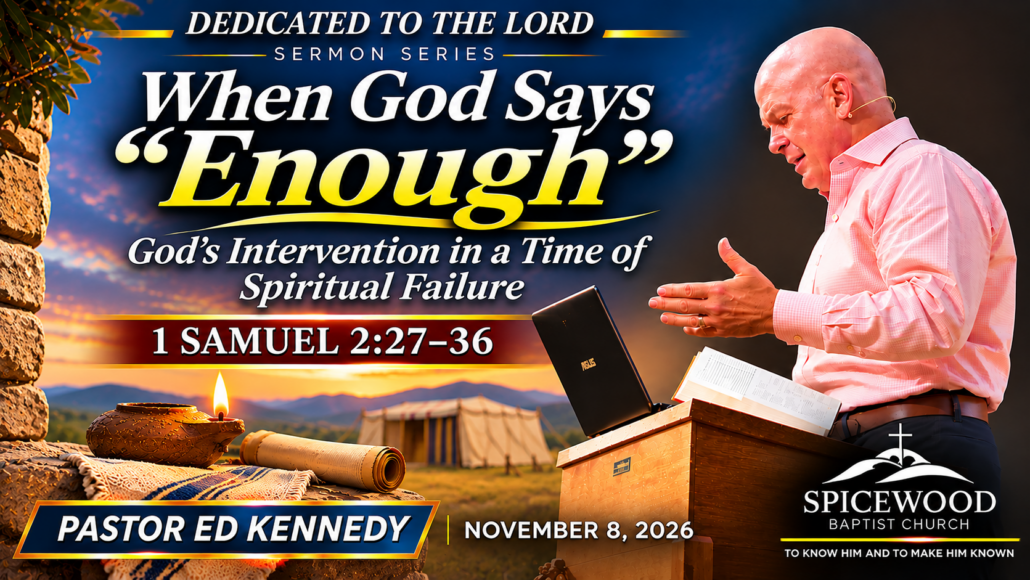
November 8, 2026
Speaker: Ed Kennedy
Topic: 1 Samuel, 1 Samuel 2, consequences of sin, Contentment, Day of Reckoning, Dedicated to the Lord, Eli, Eli's sons, faith in Christ, forgiveness, God's Intervention, God's judgment, God's Preferred Future, God's provision, grace, honoring God, misplaced priorities, obedience, Repentance, resisting God, salvation, Samuel, sowing and reaping, spiritual compromise, Spiritual Leadership
The Day of Reckoning Embracing God’s Preferred Future by Honoring… read more
-
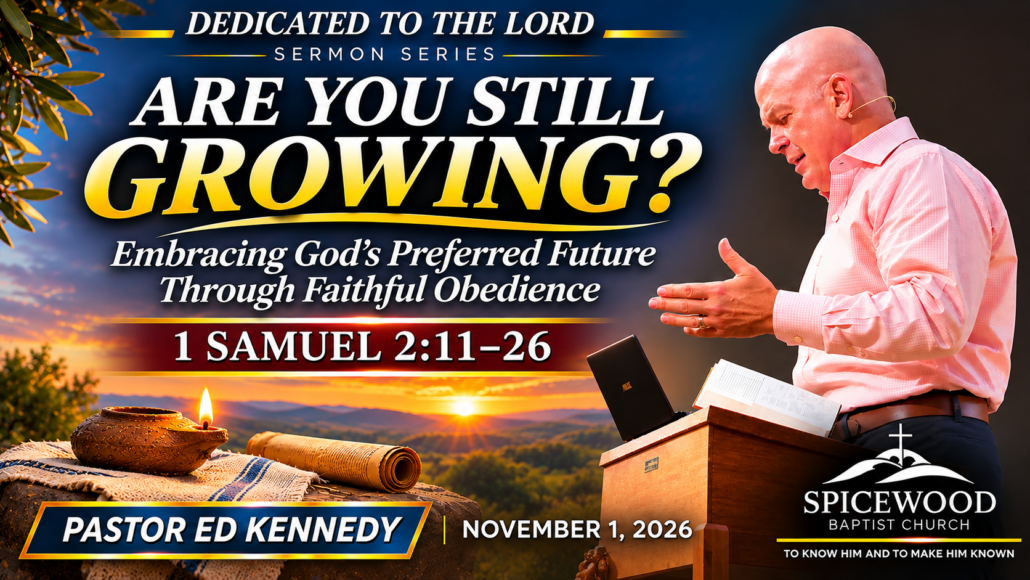
November 1, 2026
Speaker: Ed Kennedy
Topic: 1 Samuel, 1 Samuel 2, 1 Samuel 2:26, Christian Character, Christian Living, Christian Maturity, Christian Relationships, Christian Stewardship, Church Growth, Church Renewal, discipleship, Eli, Elkanah, Faithful Obedience, Faithfulness, Family, forgiveness, God's Intervention, God's Preferred Future, God's Will, God's Word, Growing in Faith, Growing in Grace, Hannah, Hophni and Phinehas, integrity, Life Change, marriage, Parenting, Personal Transformation, Repentance, Samuel, Spiritual Complacency, Spiritual Decline, spiritual growth, Spiritual Leadership, surrender, Trusting God
Book: 1 Samuel, 2 Peter, Colossians, Hebrews, Luke, Philippians, Romans
Embracing God’s Preferred Future Through Faithful Obedience Pastor Ed Kennedy… read more